Dr. Maria Montessori’s Educational Perspective
The most important feature of the Montessori Method is that it is built upon its own distinct educational philosophy, and unlike many philosophers before her, Maria Montessori did not develop it from a life removed from children. In the early 1900s, in the San Lorenzo district of Rome, which was home to low-income families, she began developing her method by working with children and observing them. It is for this reason that when describing the educational method she created, Maria Montessori said, “I studied the child. I took what the child gave me and expressed it. That is the Montessori Method.”
Today, Montessori Education is primarily applied around the world at preschool and elementary levels. However, in some countries, there are Montessori schools that continue up to the university level.
The Montessori Philosophy
Montessori’s educational philosophy differs greatly from the traditional view, mainly because of how it perceives the child. According to Dr. Montessori, children learn, think, and perceive in a completely different way from adults. Therefore, trying to view the child as an “incomplete” version of an adult and educating them accordingly is nothing but perpetuating a mistake that has been made for thousands of years. Children have their own unique needs. The only thing an adult can do during a child’s development is to remove obstacles and meet those needs. The goal of education should be to enrich the experiences children can have during this period when they are building themselves and to offer experiences that advance their development.
The Montessori Method identifies two main developmental periods: the first from birth to age six, and the second from age six to twelve. A Montessori classroom for children up to age six is called “casa dei bambini,” which means “children’s house.” In the children’s house, children learn and develop at their own individual pace and according to their personal ways of learning. Montessori refers to the education provided in the second developmental period as “cosmic education.” During this phase, the child understands the world and life as a whole, including themselves within it.
The first stage of development is predominantly based on individual experiences, because development is an individual process. During this period, the child forms a large part of their brain and personality. If, as in traditional education, children are taught content determined by the teacher at a pace also set by the teacher, their development is clearly hindered. In the Montessori Method, these negative aspects of traditional education are completely eliminated. Unlike traditional education, the education given through the Montessori Method is a positive support for all areas of the child’s development. This method has been applied worldwide for over a hundred years, and its success is impressively demonstrated by its graduates (see “Famous Montessori Students”).
The Montessori Method, unlike any other educational approach, supports the child’s independence and freedom within boundaries and responsibilities. A child is born with the desire to be a self-sufficient individual. This desire will grant them freedom and independence. However, current child-rearing practices and traditional education support making decisions on the child’s behalf and placing the child’s life under adult supervision, rather than giving them freedom and independence. Unfortunately, as a result of this incorrect practice, the child grows up without developing the skills they will need for adult life. This is precisely why education through the Montessori Method is of great importance to a child.
The main tenets of the Montessori Method are as follows:
A child is not an inadequate individual. Like all living beings, a child wants independence, and for the child, the goal is to stand on their own two feet without anyone’s help.
One must respect the child; otherwise, by not giving them the opportunity to make their own choices, we fail to correctly assess the child’s personality, cannot truly get to know them, and continue being an obstacle to their development. The only solution is an adult who can guide the child.
A child is capable of managing their own learning process in accordance with the needs of their development.
Children acquire and learn information differently than adults do.
Knowledge about a child’s development is obtained by observing the interaction of the child with an environment arranged according to the Montessori Method. The teacher’s observations are evaluated, and the child’s progress is tracked and organized based on these findings.
During the developmental process, there are times when a child is more sensitive to certain stimuli in their environment. During these periods, learning is much faster, more intense, and has a stronger impact compared to other periods. In the first six years of life, children become inclined toward language, social relationships, developing and refining their senses, and classifying and grading information, all during these sensitive periods. Therefore, the environment the child is in must be arranged in a way that supports and is suitable for their development.
The first six years of life are more valuable than any other period that follows. Children construct a large part of the life skills they will use in adulthood during these first six years. Most importantly, a child’s ability to receive and process information is very high during this time and must be utilized in the most efficient way possible.
In the first six years, providing information verbally to children is a futile effort. Children in this period learn by doing and experiencing in an absolute sense. The question is how to enable the child to experience the process of receiving and evaluating information. Montessori materials let children discover knowledge through hands-on experience because knowledge is no longer merely verbal or abstract but something tangible they can manipulate with their hands.
Independent problem-solving skills are supported, and children are encouraged to stand on their own two feet.
The Montessori Method aims to develop all of a child’s characteristics as far as possible, treating the child as an individual. The goal is to raise them to ask questions and find answers to those questions. What truly matters is that the individual can be self-sufficient. At its core, the Montessori Method is a form of life education that raises individuals who produce and are happy.
The Prepared Environment in the Montessori Method
A child’s first steps mark a turning point in their development. They go from being in a stationary position to being capable of movement. This change makes the child enter a period when they are sensitive to movement. Montessori believes that a child’s movements serve a purpose: to gain mastery over their own body. This mastery is a reciprocal relationship—body learns to master mind, and mind learns to master body. Therefore, children move with a goal in mind, and that goal is independence and self-sufficiency. In the Montessori Method, the child’s movement is referred to as “work.”
In the early years of life, transferring information verbally is not possible because the child still lacks the most fundamental knowledge. Concepts of space and time are not inherent but acquired through living. The concept of space is gained by moving one’s body continuously within space. The concept of time is learned by perceiving and measuring change. Furthermore, children do not yet have concepts for classification, ordering, or attributes like quality and quantity.
Hence, a child obtains information by experiencing the environment they live in. Only then can the brain develop and the prerequisites for learning be met.
In a prepared environment, everything is scaled to the child’s size. Therefore, the child has complete freedom of movement within the space. They can modify and use the space according to their own will. As a result, the child can use the environment without needing an adult’s help, which gives them the perception of being a self-sufficient individual. Naturally, this is the only way they can develop their abilities to the fullest extent. The fact that the environment is scaled to the child’s size makes them feel that it is prepared for them. The child’s physical and mental development occurs within this space through movement.
Order in the Environment
The concept of order emphasized in the Montessori Method differs from how adults understand it. For adults, being orderly means being neat, whereas for children, order has to do with the relationships between objects. This is because children can only understand and learn the functions of objects when these objects are a part of a whole. A few forks placed randomly do not provide information about what a fork does, but a fork placed next to a plate on a set table gives the child clear information about the function of a fork. In a Montessori school, all the materials are arranged according to a specific order, and each item is functionally related to other items in its surroundings. The way reading and writing tools are placed together in a certain arrangement serves as an example of functional order. Moreover, the locations of the materials do not change; thus, children pick up the tools they want to work with from the same place and return them to the same place. Not altering the environment allows children to repeat the same task in the same way multiple times and develop their skills to the highest level, mastering what they do.
Being in a physically ordered environment during the time they first receive information about the world gives children a sense of security. In Montessori schools, this sense of security for the child is fully supported.
Clearly, the environment must be a living entity, managed and arranged by a higher intelligence—adults specially trained for this purpose must design it.
According to the Montessori Method, the environment consists of six main parts:
Freedom: In the early stages of development, a child has the ability to choose the information they need. Therefore, within established rules, the child should be allowed to act freely.
Structure and Order: For the child, being in an environment with the same arrangement every day is the key to developing concepts of space and time. To maintain order, each Montessori material is placed and presented in a specific arrangement. There is only one of each material in the classroom. This teaches children their limits. They learn to wait their turn. They also learn problem-solving or self-control while waiting for the material they want to use. This way, children begin to perceive the overwhelming diversity they are born into in a more orderly way.
Reality and Nature: The daily tools in the classroom are real (for example, breakable glass or ceramic materials, and a running sink). Thus, children gain more accurate information about the real world (ceramic breaks when it falls, but plastic doesn’t). The children are also responsible for the animals and plants in the classroom and garden. In this way, they learn to distinguish between living and non-living things and, of course, gain an understanding of how nature works.
Beauty: Beauty comes from the simplicity of the environment.
Atmosphere: It should always convey a sense of purposefulness and productivity.
Montessori Materials: Montessori materials are designed in such a way as to capture the child’s attention and enable them to focus. In a Montessori classroom, these tools are arranged in specific areas according to a special layout.
Montessori Materials
Sensorial Materials
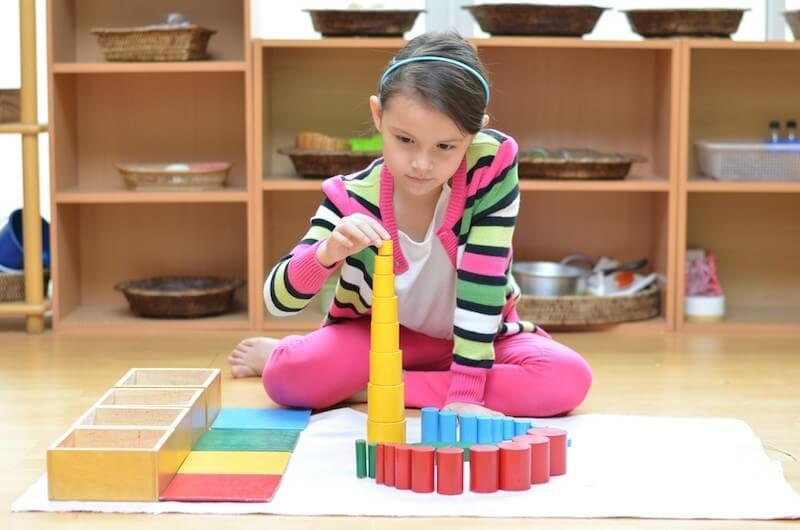
The most well-known of the Montessori Materials is the Pink Tower. Children begin working first with the Pink Tower. This material is designed to develop the sense of dimension and teach sequencing based on changes in size. Children are not born with a complete sense of dimension; most of this skill develops in the first six years, enriched by appropriate activities. Architects, engineers, painters, and sculptors have a very refined sense of dimension. They can “walk around” in the imaginary designs they conceive and visualize the three-dimensional form of an entirely abstract idea. Progress in abstract thinking is seen as equivalent to success and is regarded as one of the most distinguishing features of human intelligence.
In the Montessori Method, Sensorial Materials are particularly sensitive and carefully designed to develop a sense of dimension. Colored Cylinders change in diameter and height in proportional ways. For example, while the blue cylinders maintain the same diameter but become shorter, the red cylinders show an inverse proportion: as diameter decreases, height increases. The yellow cylinders, on the other hand, have a direct proportion: as diameter decreases, height also decreases. As long as the child works with these materials, they perceive these changes both with their hands and their eyes. A hundred years ago, Montessori talked about our hands being a learning tool, something modern science has only recently come to appreciate for its fundamental role in learning. If our hands are involved in the learning process, learning takes place in an excellent manner; otherwise, as in traditional education, you might simply show a child a picture of a tall and a short tree and expect their sense of dimension to develop.
Montessori says, “You cannot put something into the mind if you have not put it into the hands.” Montessori Materials allow the child to take hold of knowledge with their hands.
A famous modern architect and painter, Friedensreich Hundertwasser, attended a Montessori school in Vienna between 1936 and 1937. Years later, he mentioned the significant impact of Montessori Materials on his choice of colors. The building in the photograph is in Vienna and is known as the Hundertwasser House. It indeed seems to have been inspired by the Colored Cylinders.
Practical Life Materials
Practical Life exercises are the first activities presented to new children in Montessori classrooms. Each tool is intended not only to extend their attention spans but also to develop hand–eye coordination. In the photo, you see a child sewing a button—at first glance, it appears very simple, but holding the button in place while threading the needle through its hole can be challenging for a child whose hand muscles are still developing. When you watch children engaged in Montessori activities, you can see how they concentrate on their tasks. Focusing attention on one point by an act of will is a skill that develops gradually from a very young age, but unfortunately, this development doesn’t happen spontaneously. The child must engage repeatedly in activities that allow them to focus their attention. These types of activities form the backbone of the Montessori Method and are one of the indicators of its success.
Setting the table for a friend and being a host are among the most loved Practical Life activities. Table arrangement and, most importantly, hospitality are essential social skills. Asking your guest, “How many cookies would you like?” or striking up a conversation while drinking milk together are social behaviors we learn and develop by doing them together. However, sadly, children do not show the desired progress in the skill of socializing—one of the most basic human abilities—because they do not encounter environments where they can see and practice such behaviors themselves. Regardless of which university they graduate from, it should be remembered that communication skills are what truly matter. In his article, Ken Asch explains how, in Montessori Education, even preschool children are encouraged to chat with each other at the table, thus developing positive social behaviors.
Mathematics Materials
“Numbers are abstract tools produced by humans.”
When you first encounter such a definition, it can be confusing, and that’s perfectly normal. While Piaget suggested that the human mind cannot grasp any abstract concepts before age seven, Montessori noted that language is also abstract, yet in the first year of life, a child makes incredible progress in terms of language, correct pronunciation, and vocabulary. Building on that insight, Maria Montessori diverged from her contemporary Piaget and designed materials to teach numbers to children starting from age two.
In the photo, the child recognizes the symbols of the numbers (including zero) and knows the quantity (cardinal value) each number represents. For children raised with Montessori Education, math is part of daily activities.
Learning is like building a structure: while each new concept explains more than the one before it, it must also integrate with the child’s existing knowledge and set the foundation for what comes next. Proper content (curriculum) suited to the child’s development should achieve just that. Considering all its scope, Montessori Education builds interrelated structures in every area of the child’s development. After learning the numbers up to 10, children move on to the 10–19 Sequin Boards, their first introduction to the decimal system. Once they learn 10–19, they progress respectively to the 10–90 and 11–99 Sequin Boards, ultimately learning numbers up to 100. Merely counting to 100 doesn’t mean the child truly understands the numbers; children grasp the concept of numbers once they learn both their quantities and their symbols. The development of the number concept takes time, and a child working from ages two to four will master numbers up to 100.
The child in the photo has formed the quantity of 5256 and has also written and read it using the cards. The satisfaction of achievement is clearly visible here. Working with Montessori Materials is not like studying in the conventional sense; children work willingly and happily. Working and succeeding are both enjoyable experiences.
Literacy Materials
Becoming acquainted with reading and writing tools within the first six years of a child’s life is extremely important for their future literacy skills. Maria Montessori held ideas different from her contemporaries regarding the child’s ability to understand and use abstract concepts. Indeed, not only in Montessori’s time but even today, there are educators and psychologists who do not agree with her. However, postponing the skills we can develop in a child does not contribute anything positive to their development.
Montessori Materials are designed so that the child can progress comfortably, without being rushed, and without intervention from anyone but the child. While working with the materials, the child is in an entirely new field of experience. In the photo, the child is five years old, learning to hold a pencil and draw structured lines while working with Metal Insets. The child’s first encounters with writing tools usually start with freeform activities.
The child’s hand muscles need to be sufficiently developed for writing, but there is no need to wait for full muscle development before learning to read. Reading is simply voicing the symbols belonging to particular sounds. Understanding what one reads is a more advanced stage in reading instruction.
Before children start writing with their hands, they can move on to writing and reading using the Moveable Alphabet Box designed by Montessori. For a child to develop a positive attitude toward reading and writing, these first experiences must be good ones. Providing a flood of reading and writing information to children who begin primary school without any preparation can be negative for their first experiences. School life becomes a very heavy burden for them. Yet, a child’s proper introduction to reading and writing is extremely valuable for their life. Literacy materials in Montessori can be used as early as ages 4–5.
Transitioning to handwriting is the next step after adequate development of hand muscles. Short words are selected, and using various cards prepared with pictures matching those words, the child recognizes the written form and partially reads them.
Each child has a notebook that starts with line exercises and progresses to writing short words, sentences, and eventually brief written narratives. As the lines in their notebook fill up, the child’s confidence in their own academic success grows. Children who start primary school with this confidence are, as expected, one step ahead of the others. Contrary to popular belief, they are not bored at school. Most importantly, school does not become an overwhelming burden for them. Children who begin school with the confidence of “I can do it” are more successful than their peers.
We read books side by side. Books are always within children’s reach, and reading corners are organized to be especially inviting. Our love for books is always abundant.
Culture
These materials, aimed at introducing the world and the diversity of living things on Earth, are among the most important sections of the classroom. Here, the child learns about various cultures, civilizations established at different times in history, living beings for whom we are responsible, and nature, which we need to protect.
Geography, history, and biology knowledge develops the child’s perception of their surroundings. A child who receives this information effortlessly forms their personal worldview in a way that considers not only themselves but also all living things.
The art area is also part of culture for Montessori. Art is the way humans express themselves through an inner, different, and original language. The center in a Montessori classroom introduces children to different art forms and art languages. What matters is not the product that emerges but the experience of art itself. While encouraging the child to have this experience, the primary goal is that they can express themselves freely. During these activities, concepts of color and form are also covered. Children’s awareness of patterns and relationships between them—one of the most important concepts in mathematics—is supported.
In the art area, the child is introduced to the artworks and artists of different cultures. Thus, the child gains a broad perspective on how other people interpret the world.
Children who encounter art at an early age develop a sense of beauty and gain refined tastes.
Characteristics of Montessori Materials
Each set of materials presents only one concept, thus eliminating all other stimuli that could affect the meaning of that concept and focusing attention solely on that concept.
Each set of materials has pieces that demonstrate the largest and smallest values of the concept it aims to teach (long and short, big and small, wide and narrow, etc.), because relative concepts can only be taught this way.
The materials are designed to teach concepts progressively from simple to complex, and eventually from concrete to abstract, and they are introduced in this sequence.
Each material lays the foundation for more advanced concepts that will follow.
The most important feature of Montessori Materials is that they have a built-in control of error. This mechanism enables the child to learn independently, meaning they work with the material without needing adult help and can evaluate the result of their work themselves.
How Are Presentations Done in Montessori Education?
Montessori Materials are introduced to the child by their teachers or other children when the child is ready, so the child can see how to use the material for its intended purpose. Each work is designed to move the child to a more advanced cognitive level. The materials follow one another, and in terms of level, each previous material is less complex and simpler than the next one. The fact that the materials in the curriculum follow each other in this way ensures that the child’s knowledge is always built on a foundation, just like placing bricks to build a wall.
Learning does not happen without repetition. However, in traditional education, the subject matter to be learned is presented within a time determined by the institution, and once that period is over, they move on to another subject. Yet every child’s learning style and need for repetition is different. In the Montessori Method, the child regulates their own pace of study and takes charge of their own learning process. This is an extremely important skill for a person to acquire.
Children who work with Montessori Materials begin by learning through concrete objects and their senses, then develop abstract thinking skills, advancing in writing, reading, math, and the social sciences, becoming individuals who love working and learning.
A Day in a Montessori School
In traditional education, when weekly schedules are prepared, each age group is thought of as a single class, and each group has its own space within the school. However, every child should be able to use the entire school, and once they enter a class in the morning, they should not have to remain in the same place until evening. One significant difference at Sihirli Bahçe Montessori School is that there is an arrangement within the weekly schedule that allows children to use the entire school.
In Montessori’s first school, all lessons in different subjects had to be conducted in the same space because they had only one large room that they used as a classroom. Montessori materials were kept there, and in this same space, they both worked, prepared and ate their meals, and slept. Today’s schools have much different layouts, and in addition, it is possible to provide supplementary lessons alongside Montessori activities in order to support the children’s development with a rich variety of experiences.
These new conditions led us to prepare a more efficient weekly schedule, and for six years we have implemented a special arrangement. According to this arrangement, children do not spend their entire day in the classroom that has Montessori Materials, nor in any other single classroom. Supplementary lessons such as music, art, physical education, English, drama, scientific experiments, and of course garden play or caring for flowers, vegetables, and animals, playing house, or building castles with construction toys (and countless other activities) should be part of the child’s weekly schedule.
As part of Montessori Educational Consultancy, we determine a school’s needs based on the age range and number of classes and prepare a weekly schedule for them. In this case, Montessori Materials do not need to be in every corner of the school; while one class is in a 2–3 hour uninterrupted Montessori work cycle they need, another class can be in music and art lessons or go outside to the garden. Mornings and afternoons are arranged across the school with a special system of sharing. Thus, while ensuring continuity in Montessori Education, we also support development in other areas. Meanwhile, the school environment is utilized in the most efficient way possible, and no child is excluded from any activity happening in the school.
Evaluating the Child’s Progress
While the Montessori Method measures a child’s development through their work and achievements, traditional methods measure it with grades, tests, and report cards. It is clear that trying to measure development in this manner reduces the act of learning to a negative competition, where the only goal is a test result; however, the real objective is to learn, grow, and advance.
In the Montessori Method, evaluation is determined by careful observations made while the child is working with the materials. It is well known that especially in the first six years, any kind of traditional evaluation cannot be applied to children, and that the tests considered to measure development actually provide quite limited, generalized information about children. Therefore, the observations gathered while the child is working are not only about the child’s work with materials, but also include the movements they make during physical education, as well as the conversations they have with friends while playing games. The observations collected about the child are evaluated according to both Montessori’s principles and criteria from developmental psychology. In the Montessori Method, rather than a report card that assigns numerical values to a child’s progress, the child’s development is assessed through the work they have done, the teacher’s observation records, and the regular oversight by educational administrators. The child’s accomplishments, strengths, and weaknesses are noted in these records, and suggestions are provided.